
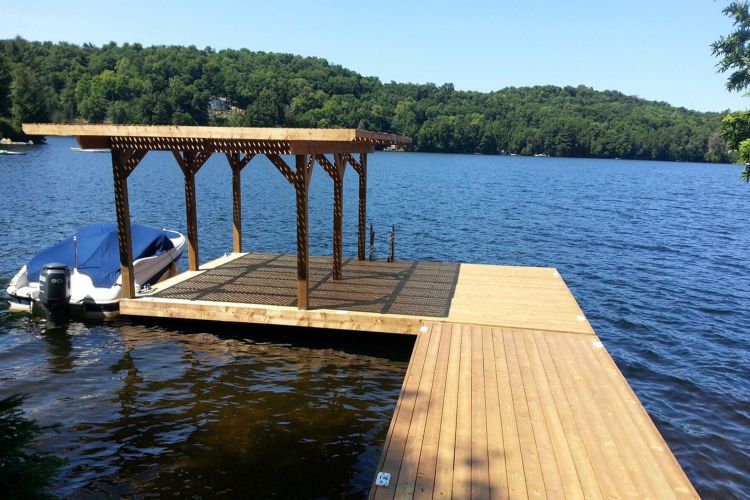
A properly planned dock is a long-term project that helps to maintain safety, functionality and property value. Although it is true that routine maintenance is important, careful design choices taken during the building or remodeling phase also contribute much to the lifespan of a dock. It can be stated that dock owners can provide much prolongation of lifespan by paying attention to materials, structure, and environmental conditions, as well as decrease the future repair cost and disruptions.
Material Selection
One of the best methods of increasing the lifespan of docks is the selection of durable materials. The modern composite decking, treated lumber, and marine-grade metals are designed to resist the entry of moisture, rot and corrosion. The materials are better than the traditional ones in that they last longer when used in places where there are changes in the levels of water or where the sun has a great impact. Material selection is smart and lessens the warping and cracking, thus maintaining structural integrity.
The choice of the material should also be based on the use of the dock. As an example, docks used frequently to launch small watercraft should have an anti-abrasive and anti-algae surface. A hydraulic boat lift can be made using textured composite panels to avoid contact with equipment repeatedly without loss of traction or the surface wearing out as the years pass.
Structural Design
Good structural design is such that loads are evenly spread on the dock system. Framing that is reinforced, with correct spacing of joists and with improved fasteners, all minimizes stress areas that may reduce life. During construction, stronger or more secure pilings may be invested in to avoid the occurrence of shifting and settling, which are the factors that cause long-term dock failure.
Another factor is designing for the future. Docks that have the flexibility to add additional additions or equipment will not need significant changes in the future. As an illustration, when a boat house cable lift is to be planned, it is better to plan it initially to prevent retrofitting stresses that may result in the weakening of the dock in the course of time.
Environmental Considerations
The effect of the environment on the docks is direct, which implies that adaptive design is crucial. By considering the wave actions, change in water depth and ice movement, structural parts are not subjected to recurrent impacts. Floating sections or breakaway elements have the benefit of relieving strain during storms and seasonal transformations to maintain both the dock and the shoreline around it.
Environmentally friendly design decisions may also increase the life of docks. The ability to allow water flow underneath the building will minimize the development of moisture and restrict the growth of organisms. The choice of finishes and coatings that are specific to the marine environment continues to protect the materials against UV and water infiltration to ensure that the dock continues to be useful and appealing over several years.
Long-Term Planning
The issue of dock life depends on strategy in the long run. An environmentally conscious design will perform better than a design that is concerned with only the initial cost. When the dock owners are concerned about smart design alterations, they tend to have fewer repairs, enhanced safety, and greater overall performance.
With a team of effectively trained experts and a properly designed dock, one can have a dock that lasts decades. Although careful planning is being done now, the structure will be able to sustain recreation, access and enjoyment of the water in the future.
The process of increasing the lifespan of a dock is not realized by maintenance alone, but rather by deliberate design decisions that presuppose its long-term use and exposure to the environment. Dock owners can decrease the effects of wear and tear by choosing hardy materials, reinforcing structural components and taking into consideration the forces of nature like the movement of water and weather, which are expensive to repair. The design is intelligent enough to make the dock age, as opposed to breaking down. A dock can be a strong and trustworthy waterfront asset when its design choices are made flexibly and considering the future requirements.
